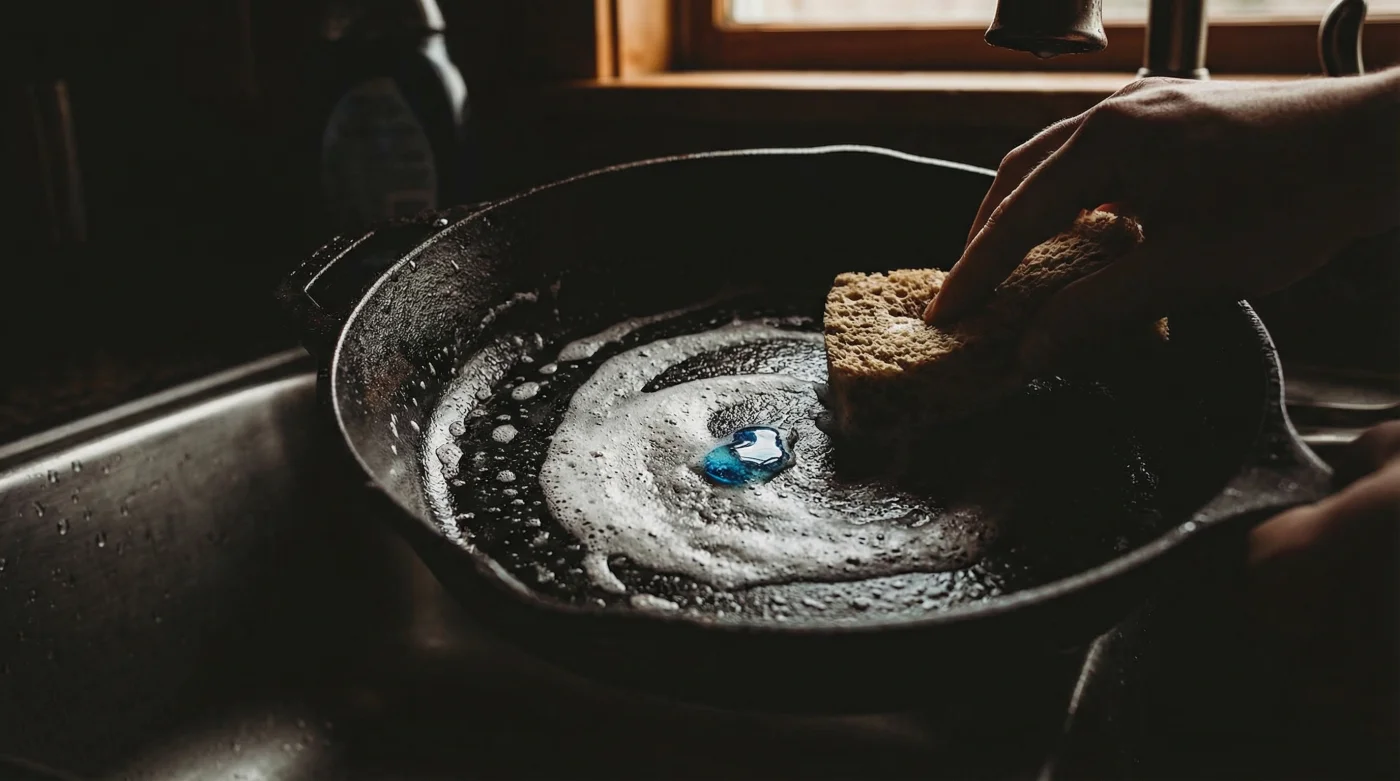
The morning light filters through the frost on the kitchen window, casting a pale glow across the stove. You pull the heavy skillet from the burner, its dark surface a familiar comfort on a cold Canadian morning. It feels substantial in your hands, carrying the physical weight of countless Sunday breakfasts and late-night seared steaks. You drop a knob of cold butter into the centre; it spits and foams immediately, smelling faintly of yesterday’s roasted garlic and woodsmoke.
You have likely inherited a set of rigid, anxious rules along with that pan. Never use water if you can help it. Never, under any circumstances, let a drop of soap touch the black metal. You probably wipe it down with a dry paper towel, leaving a slick, sticky film behind, quietly convinced you are preserving the soul of the cookware.
But the next time the iron heats up, a faint, acrid smell fills the room. The smoke point seems inexplicably lower. Your fried eggs stick just a little more than they did last month, tearing at the edges when you try to flip them. You brush it off as a failure in your technique, assuming the pan simply needs another hour baking in the oven, slicked with another heavy coat of flax oil.
The truth is far less romantic and vastly more practical. The reluctance to wash your cookware is not building a resilient non-stick surface; it is actually layering rancid, oxidizing fats that silently degrade the flavour of every meal you cook.
The Chemistry of a Clean Slate
To understand where this deeply ingrained kitchen myth originated, we have to look back at the soap your grandmother used. A century ago, household soaps were made with harsh lye. Lye is highly caustic; it will strip paint from wood, and it absolutely would strip the hard-earned finish off a cast iron pan. The rule was born from necessity, designed to protect the metal from chemical erosion.
Real seasoning is not a liquid coating of grease resting on the surface. When oil is heated past its smoke point, it undergoes polymerization. The fat transforms into a hard, plasticized shell that has bonded to the iron at a molecular level. It is tough, durable, and completely impervious to the mild surfactants in modern dishwashing liquids.
Modern dish liquids, like the standard green Dawn or yellow Sunlight sitting by your sink, do not contain lye. They are gentle detergents formulated to break down loose, unbonded oils. When you wash your skillet with soapy water, you are only removing the dirty, decaying food residue. The polymerized shell remains completely intact, breathing like clean enamel.
Sarah Lemieux, a 48-year-old culinary restorer in Montreal, spends her days resurrecting abused cookware. “People bring me skillets that smell like old crayons,” she notes, rubbing her thumb across a gummy, brown rim. “They are terrified of soap, so they just keep painting fresh grease over old bacteria. The first thing I do is scrub them in scalding soapy water. The iron underneath is always desperate to breathe.”
The Friction Profiles
This shift in perspective requires breaking a long-held habit, but how you apply this cleaning logic depends entirely on what you cook. Let us look at how your cooking habits dictate your maintenance routine, ensuring your skillet remains a reliable tool rather than a kitchen chore.
For the Sunday Sizzler
If you primarily pull the heavy iron out for weekend bacon, thick pancakes, or a sweet maple-glazed pork chop, your pan is exposed to high amounts of sugar and sticky proteins. These elements caramelize and burn quickly, leaving microscopic carbon deposits in the iron’s pores.
Here, the risk of carbon buildup is much higher than the risk of stripping the finish. You must wash away the residual sugars immediately with hot water, soap, and a stiff brush. Leaving bacon grease to cool in the pan does not season it; it simply creates a sticky trap for dust and future food particles.
For the Nightly Searer
If your skillet lives permanently on the stovetop, searing chicken thighs, charring bell peppers, and finishing thick steaks every single evening, the pan is constantly being subjected to high-heat friction. The oil is polymerizing naturally through regular, intense use.
For the heavy user, the pan barely needs formal re-seasoning. Because the heat cycle is so frequent, just a quick scrub and dry keeps the surface flawlessly smooth. You can confidently hit it with soapy water to remove the fond, knowing tomorrow’s dinner will immediately reinforce the slick patina.
The Reset Ritual
The goal is mindful maintenance. You want to shift from treating your pan like a fragile artifact to treating it like a robust, high-performance tool. This requires using a few calculated, minimal actions rather than an agonizing process of scraping and baking.
- Cool down, but do not turn cold: Allow the skillet to cool until it is safe to handle, but wash it while it is still warm. A warm pan releases food bonds much faster.
- The soapy scrub: Apply a drop of mild dish soap to a stiff-bristled nylon brush or a chainmail scrubber. Scrub the interior, exterior, and handle under hot running water.
- The immediate dry: Never let cast iron air dry. Wipe it thoroughly with a lint-free cloth or paper towel.
- The stovetop bake: Place the dry pan on a burner over medium-low heat for three minutes. This evaporates any microscopic moisture trapped in the iron’s pores, preventing flash rust.
Once the metal is perfectly clean and bone dry, it is ready for a micro-layer of protection. The iron’s pores are open from the heat, waiting to accept a fresh, clean coat.
The oil you choose matters. While the pan is still warm, take a paper towel and rub a single drop of canola or grapeseed oil into the cooking surface. Then, take a clean paper towel and try to wipe it all off. You want the thinnest possible layer. Let it cool on the stove. Your pan is now hygienically clean, protected, and primed for tomorrow.
Beyond the Black Iron
Maintaining your cookware should not feel like walking on eggshells. The kitchen is a place of sensory creation, not a museum of rigid anxieties. When you understand the basic mechanics of heat, fat, and steel, you stop following blind instructions and start working intuitively with your tools.
Shedding the myth that soap ruins cast iron is incredibly freeing. It allows you to cook heavily spiced curries, acidic tomato sauces, or delicate fish without the lingering fear of ruining the finish. You simply wash the slate clean, dry it thoroughly, and start fresh. That is the true beauty of iron: it always forgives you, and it always bounces back.
“A pan is a tool, not a museum piece. Keep it clean, keep it hot, and it will feed your family for generations.”
| Key Point | Detail | Added Value for the Reader |
|---|---|---|
| Soap usage | Modern dish soap contains no lye. | Eliminates rancid oil flavours from your meals. |
| The drying process | Towel dry, then heat on the stove. | Prevents micro-rust from forming in the iron’s pores. |
| Oil application | Micro-thin layer of grapeseed or canola oil. | Creates a durable, non-sticky polymer shell over time. |
Frequently Asked Questions
Does soap remove cast iron seasoning?
No. True seasoning is polymerized oil baked into the iron. Modern dish soap only removes loose, unbonded grease and food particles.Why does my skillet feel sticky?
A sticky surface means oil was applied too thickly or not heated to the point of polymerization. It is simply rancid grease, not seasoning.Can I use a metal scrubber?
For stubborn, burnt-on food, a chainmail scrubber is excellent. Avoid aggressive steel wool, which can scratch and degrade the polymerized layer.What is the best oil for a quick touch-up?
Canola or grapeseed oil. Both have high smoke points and polymerize efficiently without leaving a sticky, uneven residue.How often should I do a full oven re-seasoning?
Rarely. If you wash with soap, dry completely, and lightly oil the pan after every use, the seasoning will continuously build and maintain itself.