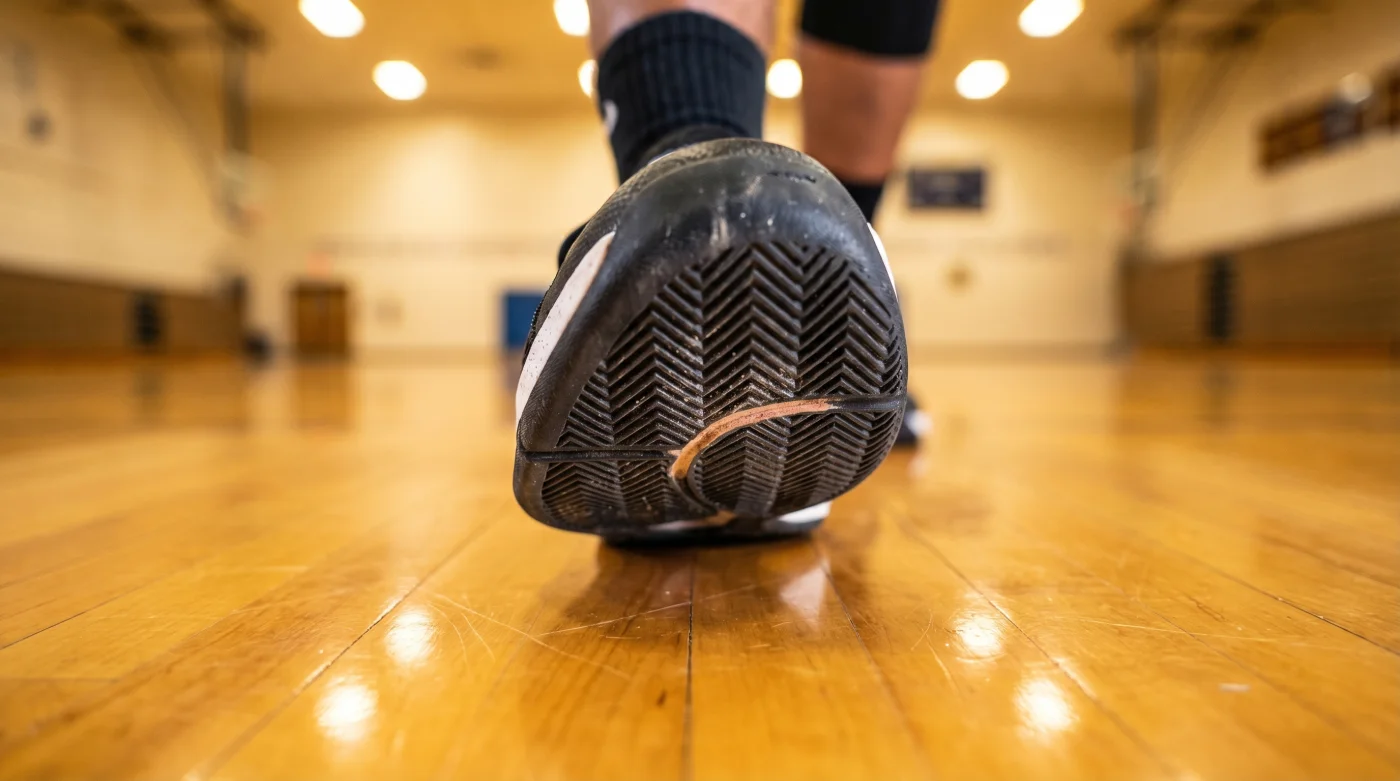
The sharp, piercing squeak of fresh rubber biting into varnished hardwood is a sound every basketball player knows in their bones. You lace up, step onto the court, and drag your toe just to hear that high-pitched friction. It feels like readiness. It feels like grip. But the second your foot stops dead on a fast break, your body weight keeps moving forward. The raw physics of that sudden halt sends a shockwave right up the shin and into the knee joint. When the knees start aching the morning after a pickup game, most of us blame age, the hard floor, or our own conditioning. We rush out to the sporting goods store to buy the thickest, squishiest shoes available, hoping to buy our way out of the pain.
You have been sold a comforting lie by the footwear industry. This is fundamentally flawed. The standard advice dictates that if your joints hurt, you need maximum impact absorption. You walk into a shop, press your thumb into a massive wedge of heel foam, and assume it will act like a mattress for your legs. But a soft, pillowy midsole actually forces your foot to constantly micro-correct. Think about doing heavy squats while standing on a mattress. Your ankles wobble, your arches collapse inward, and your knees bow to compensate for the unstable floor. Firm rubber outsoles, paired with a dense, rigid midsole, do exactly the opposite. They lock the foot in a neutral position. By sacrificing that cloud-like feeling, a firm shoe dictates strict skeletal alignment, keeping your knees tracking straight over your toes instead of drifting inward during a hard crossover.
The Marshmallow Trap and the Alignment Illusion
Consider the clinic of Dr. Elias Thorne, a 46-year-old orthopaedic specialist in Toronto who spends his evenings patching up adult-league players. He kept seeing athletes walk in with patellar tendonitis, carrying gym bags full of high-tech, max-cushion sneakers. Elias started making them perform a single-leg drop jump barefoot, and then again in their ultra-soft shoes. In the shoes, their knees instantly caved inward upon landing. The foam was collapsing unevenly under their weight. He started prescribing firm, low-profile shoes with robust rubber torsion plates. Within weeks, the chronic aches began to fade. The solution was never about softening the landing; it was about stabilizing the frame.
Not all firm shoes operate the same way. Adjusting the structural foundation depends entirely on where and how you play. The physics of your specific movement demand a precise type of rigidity. If you ignore the mechanics of your playstyle, even a firm shoe can feel clumsy.
Tailoring the Foundation
For the Agile Guard. You rely on lateral quickness and sudden changes in direction. If you wear a thick, soft shoe, your foot slides off the footbed during a hard cut. You need a shoe with a rigid lateral outrigger. This is a flare of solid rubber on the outside edge of the pinky toe. It acts like a kickstand, stopping ankle rolls and keeping the knee from snapping outward.
For the Ground-Bound Shooter. Your knees absorb massive braking forces when you run off screens and stop sharply for a jump shot. Soft shoes cause the foot to slide forward inside the toe box during this deceleration. A firm shoe with a rigid heel counter acts like a seatbelt. It stops the momentum at the ankle, preventing the knee joint from buckling forward over the toes.
For the Outdoor Grinder. If your local court is rough asphalt baking in 25 Celsius heat, soft outsoles will melt away in a matter of weeks. You need a solid, high-abrasion rubber compound. The tread grooves must be thick and widely spaced. A firmer rubber compound prevents the shoe from gripping too aggressively on outdoor concrete, allowing a micro-slide that absorbs rotational torque before it tears into your knee ligaments.
- Hold your golf driver lower to hit further
- Tie your hockey skates differently to skate faster
- Track Hormuz strait ships to spot missing goods
- Clean your cloud storage to stop paying fees
- Read Christine Fréchette plans to see new rules
- Change your mortgage loan to pay less money
- Soak cut potatoes in water for perfectly crispy fries
- Move your WiFi router up high for faster speeds
- Wash bath towels with baking soda for extra softness
- Stop ruining hot coffee by adding cold milk daily
The Structural Reset Protocol
Transitioning to a firmer shoe requires a brief adjustment period. Your feet have grown lazy inside their foam pillows. When you strip away the excess cushioning, the intrinsic muscles of your foot have to wake up and start working again. Start slow. Wear your new, rigid shoes for casual shooting drills before taking them into a full five-on-five game.
Let your body adapt to the ground feedback. Pay attention to the wear patterns on your old sneakers. If the inner heel is completely crushed, you have been battling severe overpronation. A firm shoe will correct this, but your calves will ache for the first week as they adjust to the new, healthier workload. Here is the raw checklist for making the swap without triggering new pains:
- Check the torsional rigidity by trying to twist the shoe like a wet towel. It should fight back violently.
- Look for a wide base. The sole should be visibly wider than the upper fabric to prevent tipping.
- Replace the factory insole with a rigid orthotic if you have flat feet, ensuring the arch does not collapse under pressure.
- Limit your first run in the new shoes to two miles of total movement.
The Tactical Toolkit: Aim for a heel-to-toe drop of around 4 to 8 millimetres. Any higher, and your weight shifts entirely to your toes, stressing the front of the knee. Keep your shoelaces tightest across the midfoot to lock the heel into the back of the shoe, preventing any forward sliding. It should feel heavy in your hand, signaling the density of the protective rubber.
A Foundation That Outlasts the Game
Basketball takes a brutal toll on the human body. Every jump, pivot, and sprint demands a massive tax from your skeletal system. When we mask poor alignment with thick layers of foam, we are simply pushing the debt onto our knees. Stripping away the excess and choosing a firm, stable base is a quiet act of discipline.
It demands better mechanics. When you wear a shoe that keeps you perfectly aligned, your body learns to absorb impact through the muscles rather than grinding down the cartilage. You stop fighting the floor and start using it. The sharp squeak of the court stops being a warning sign for joint pain and goes back to being exactly what it should be: the sound of a player in total control.
The court does not forgive poor alignment; your shoes should act as a scaffold, not a sponge. – Dr. Elias Thorne
| Key Point | The Flawed Standard | Added Value for the Reader |
|---|---|---|
| Midsole Density | Airy, highly compressible foams that tilt under weight | Dense, rigid materials lock the foot in place, preventing micro-wobbles that cause knee ache. |
| Outsole Grip | Sticky, fast-wearing patterns that halt momentum instantly | High-abrasion rubber allows a safe rotational micro-slide on outdoor courts. |
| Lateral Support | Soft mesh uppers with no outrigger | Solid rubber flanges prevent inward knee drift and protect against severe ankle rolls. |
Questions from the Court
Will firm shoes make my feet hurt at first?
Yes, your arch muscles need time to rebuild strength after relying on soft foam for years. The initial ache is a sign of structural adaptation.How long does it take to break in a dense rubber sole?
Typically three to five games, depending on the ambient heat and your body weight.Can I just add an insole to my current soft shoes?
A rigid insole helps, but if the shoe’s foundation is squishy, the whole platform will still tilt under heavy loads.What if I only play on outdoor asphalt?
Asphalt is far less forgiving than hardwood. Prioritize thick, high-friction rubber that refuses to compress under body weight.Are heavier shoes bad for my vertical jump?
The difference is negligible. The power you gain from a stable, firm launch base actually outweighs the burden of extra ounces.