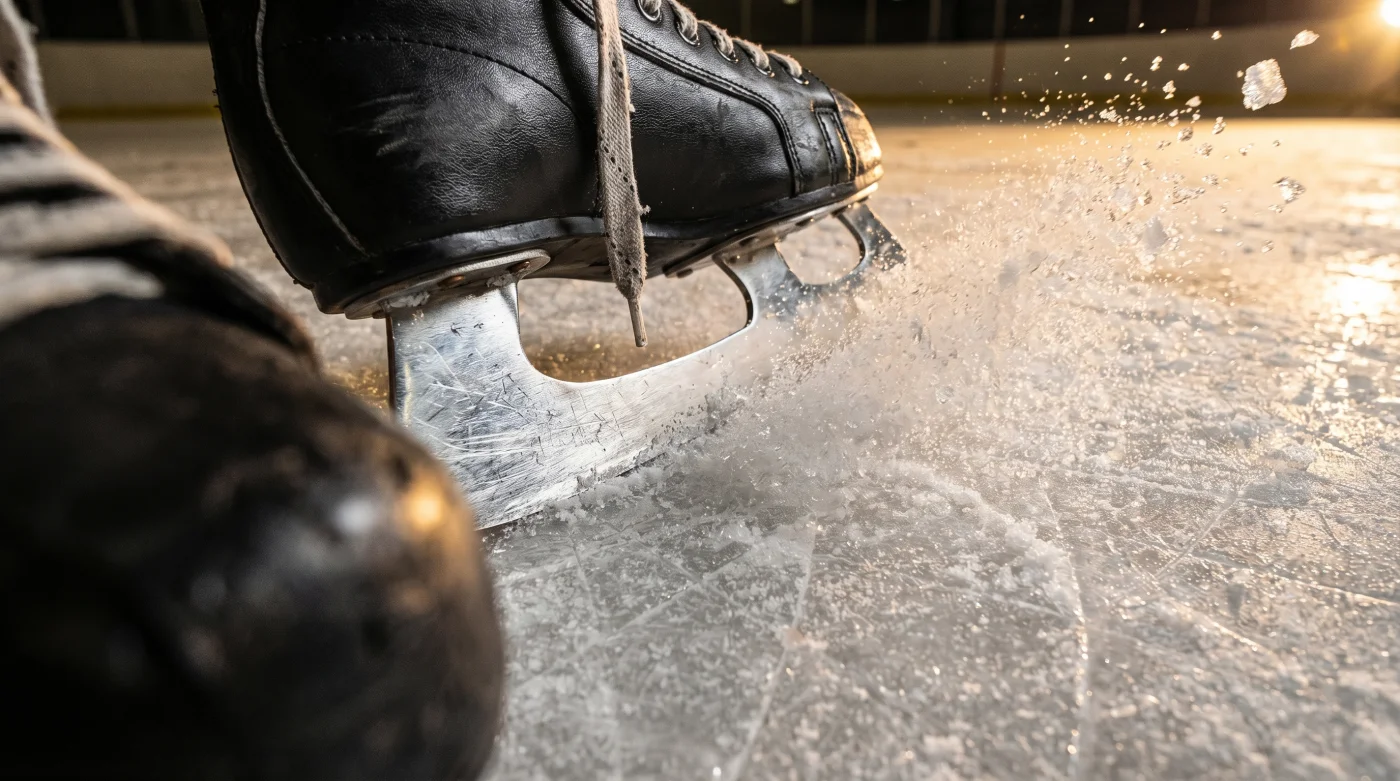
There is a specific quiet in a Canadian arena just before the 6:00 AM practice begins. You step out from the rubber-matted hallway, push through the bench door, and take that first heavy stride. The sharp sound of a freshly sharpened blade biting into a pristine sheet of ice echoes off the rafters. It is a sound that feels like cold air in your lungs, carrying the weight of early mornings and endless repetitions.
Most players stepping onto the rink at this hour are fighting their own gear. They bend their knees to initiate a stride, but their lower legs hit a wall of stiff composite material. They are bound by the strict belief that a skate must function as a rigid vice grip from the toe box all the way up to the shin pad.
We are taught from our very first learn-to-skate programs to yank the laces until our fingers blister. Parents and coaches instruct us to thread every single hole. Tie it so tight the blood struggles to reach the toes. The overarching logic is always rooted in ankle support.
But this deeply ingrained habit actually kills your forward knee bend. The tight top lace, meant to offer stability, acts as a rigid brake pad against your shin. It destroys the precise biomechanics required to generate explosive speed out of a dead stop.
The Illusion of the Cast
Think of a modern hockey boot not as a traditional shoe, but as a stiff lever. Over the last two decades, skate manufacturers shifted away from soft, forgiving leather toward ultra-stiff carbon composites. The boots became incredibly light and nearly rigid, meaning they no longer break down or soften naturally around the ankle bone over time.
When you lace a stiff composite boot up to the absolute top eyelet, you turn it into a cast. You entirely restrict the forward pitch of your shin. Without that forward pitch, your knee cannot bend deeply over your toes. Without that deep knee bend, your skating stride becomes a short, choppy march rather than a long, powerful, horizontal push against the ice.
Leaving the top eyelet entirely open shatters this flawed industry standard. It feels scandalous the first time you step onto the ice, almost like leaving the house wearing shoes without tying them at all.
Yet, intentionally dropping that single top eyelet creates a physical springboard. Suddenly, the ankle can articulate. The shin drops forward freely, the knee lowers, and the blade engages the ice at a highly aggressive angle, allowing you to access the full length of the blade’s steel rocker.
The Calgary Power-Skating Fix
Dave Tremblay, a 48-year-old power-skating coach operating out of Calgary, works largely with AAA prospects and junior players who have hit a frustrating plateau in their straight-line speed. They come to his morning sessions with pristine edge mechanics but lack the explosive separation required to beat a defenceman wide at higher levels of hockey.
His first intervention requires absolutely zero skating drills. He sits the players on the bench, bends down, and simply pulls the top laces out. He forces them to step back onto the ice and skate a hard lap with the top eyelets completely empty.
The players usually wobble for the first two strides, panicking at the sudden freedom around their lower legs. But by the third stride, their centre of gravity drops naturally. By the time they hit the offensive blue line, they are flying, utilizing heavy muscles in their glutes and quads they previously couldn’t engage because the skate boot was physically blocking their posture.
Tailoring the Lacing Matrix
Not everyone skates with the exact same posture, and adjusting to a dropped eyelet requires a slight shift in how you secure the rest of the foot. You have to intentionally map out the exact tension across different zones of the foot.
For the Heavy-Footed Defenceman
If your game relies on pivoting backward constantly and taking heavy physical contact in front of the net, you might fear losing lateral stability. The trick here is to isolate the tension. Keep the bottom three eyelets comfortably snug to allow the toes to lay flat and splayed.
Then, aggressively tighten the middle four eyelets right at the instep. This effectively locks your heel firmly down into the deep pocket of the skate. When you leave the top eyelet open, the ankle can flex forward effortlessly without the heel slipping up, giving you both bedrock stability and aggressive transition speed.
For the Shifty Winger
Wingers living on their outside edges need maximum articulation. You want to feel the ice underneath you like a lightweight running shoe, absorbing impact and shifting instantly.
Use waxed laces to dictate exact tension zones. Leave the mid-foot slightly looser so the arch can compress under load, pull the second-to-top eyelet aggressively tight, and leave the very top hole completely empty. This simple adjustment brightens the blade’s bite during tight, high-speed crossovers.
The Raw Checklist for Flexion
Transitioning away from a fully laced boot takes a few practice sessions. The smaller stabilizing muscles around your shin and ankle will need a moment to adapt to supporting your body weight rather than relying entirely on the stiff carbon wall of the boot.
Follow this mindful physical progression to safely rewire your skating mechanics:
- Swap to Waxed Laces: Traditional cotton laces stretch and loosen as they get soaked in ice snow. Waxed laces hold tension exactly where you set it, preventing the entire boot from becoming sloppy when the top eyelet is skipped.
- The Heel-Lock Pull: As you lace the middle of the boot, pull the laces outward horizontally, rather than yanking them straight up toward the ceiling. This properly seats your heel back into the rear mould.
- The Tape Trick: If skipping the top eyelet feels wildly too loose initially, lace it, but do not pull it tight. Leave a full centimetre of slack before tying your knot, giving you a mental safety net while still allowing mechanical forward flex.
- The Two-Week Rule: Give your tendons time to catch up. Commit to the open eyelet for six full ice times before making a final judgment on the feel.
Your tactical toolkit is highly accessible: a fresh pair of waxed laces, a properly baked composite skate boot, and a willingness to feel temporarily unbalanced for long-term gain.
Beyond the Morning Scrimmage
Rethinking how you tie your skates does more than just shave fractions of a second off your backcheck. It changes your physical relationship with the ice surface. You stop fighting the equipment and start working smoothly with your own natural anatomy.
The dull fatigue that normally burns in your lower back during the third period fades away because your knees are finally acting as proper shock absorbers. You glide instead of march, preserving crucial energy for when the play actually matters in the final minutes.
Sometimes the biggest barrier to our own physical progression is a habit we inherited but never questioned. You leave the rink, throw your heavy gear bag in the trunk, and realize that the simplest mechanical adjustment was sitting right there at your fingertips all along.
“You cannot build a fast skater in a boot that functions like a plaster cast; the ankle must breathe to let the steel do the work.” — Dave Tremblay, Power-Skating Coach
| Key Point | Detail | Added Value for the Reader |
|---|---|---|
| Dropping the Top Eyelet | Removes the rigid barrier against the front of the shin bone. | Allows immediate, deep knee bend for a longer stride and more speed. |
| Instep Heel Lock | Tightening only the middle four eyelets horizontally. | Secures the foot safely in the boot without compromising forward ankle mobility. |
| Waxed Lace Upgrade | Using wax-coated laces to prevent slipping and stretching. | Maintains distinct tight and loose zones across the foot for the entire game. |
Frequently Asked Questions
Will dropping an eyelet cause weak ankles?
No. It actually forces the stabilizing muscles around your ankle to engage and strengthen, rather than relying on the boot to hold your weight.Does this work for completely brand-new, stiff skates?
Yes, it is highly recommended for new composite skates. Skipping the top eyelet instantly relieves the severe shin-bite common with unbroken-in boots.Should goalies try leaving the top eyelet open?
Many modern goalies actually drop the top eyelet or use a specialized cowling to ensure they can get low into a wide butterfly stance faster.What if my heel slips up when I stride?
If your heel lifts, your mid-foot laces are too loose, or your skate boot is improperly sized. Try the horizontal heel-lock pull on the middle eyelets.Can I just buy softer skates instead?
Most modern adult skates are built stiff to transfer energy directly to the ice. Adjusting your lacing is cheaper and more effective than hunting for vintage leather boots.